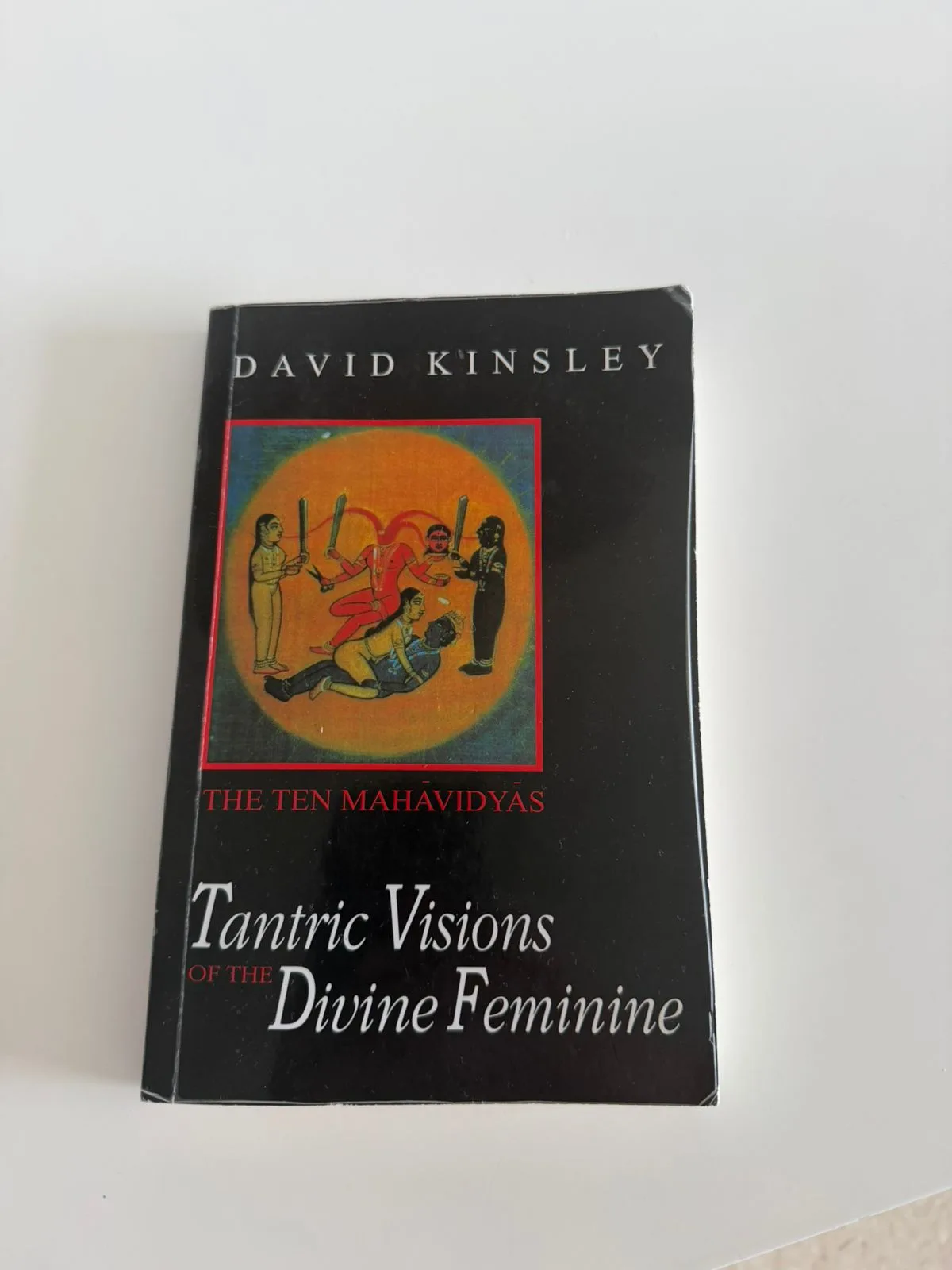
Some books inform you. A rare few sit down beside you and quietly rearrange something inside. For me, David R. Kinsley’s Tantric Visions of the Divine Feminine: The Ten Mahavidyas was the second kind. I opened it expecting a scholarly survey of Hindu goddesses. I closed it feeling larger than when I began — and a little more forgiving of the wild, unruly, unbeautiful parts of myself.
If you have read my earlier reflection on Devi Tara, the star that guides us across, you already know how close the Divine Feminine sits to my heart. This book gave me the whole constellation She belongs to — not one goddess, but ten faces of the same Mother.
The Book That Found Me
Kinsley was one of the great modern scholars of the Hindu goddess, and this book — published by the University of California Press — is widely regarded as the definitive study of the Mahavidyas, the “Great Wisdoms.” What makes it remarkable is that he never reduces these goddesses to museum pieces. He draws on Sanskrit texts, vernacular hymns, temple traditions and, most movingly, conversations with living devotees. And through all of it he treats the goddesses as what they truly are: living symbols — or as he calls them, “awakeners.”
Awakeners of what? Of a consciousness that has grown too comfortable. The Mahavidyas embody habits and identities a polite society usually calls repulsive or subversive — and it is precisely there, in the forbidden, that the devotee is invited to look for transformation. They are, Kinsley writes, “antimodels” — the opposite of every safe, socially approved image of who a woman, or a soul, is supposed to be.
“The Mahavidyas seem to function as awakeners — symbols which help to project one’s consciousness beyond the socially acceptable or predictable.” — David Kinsley, Tantric Visions of the Divine Feminine
Who Are the Ten Mahavidyas?
The book gives each goddess her own chapter. Some, like Kali and Tara, you may already love. Others — the smoky widow Dhumavati, the self-decapitated Chinnamasta — are strange and rarely spoken of outside Tantric circles. Together they are the full spectrum of Shakti, from creation to dissolution, tenderness to terror:
Kali
Time and death itself — she dissolves the ego to reveal the eternal.
Tara
The guiding star who carries the soul across the ocean of grief.
Tripura Sundari
The beauty of the three worlds — bliss and radiant perfection.
Bhuvaneshvari
Queen of the universe; the very space in which all things arise.
Bhairavi
The fierce one — the burning heat of discipline and courage.
Chinnamasta
The self-offering goddess — life endlessly feeding life.
Dhumavati
The widow, the smoky one — wisdom found in loss and emptiness.
Bagalamukhi
The stiller of speech and motion — the power to hold still.
Matangi
The outcaste goddess who sanctifies what the world rejects.
Kamala
The lotus goddess — abundance, well-being and gentle grace.
The Chapter That Undid Me: Matangi
Of all ten, it was the chapter on Matangi that I kept returning to. Matangi is the outcaste goddess — associated with pollution, the forbidden, the very lowest rungs of a rigidly hierarchical world. Kinsley explains how she is deliberately worshipped with what society calls impure: leftover food, things others have discarded. She is called Ucchishta-matangini — “she who accepts the leftover.”
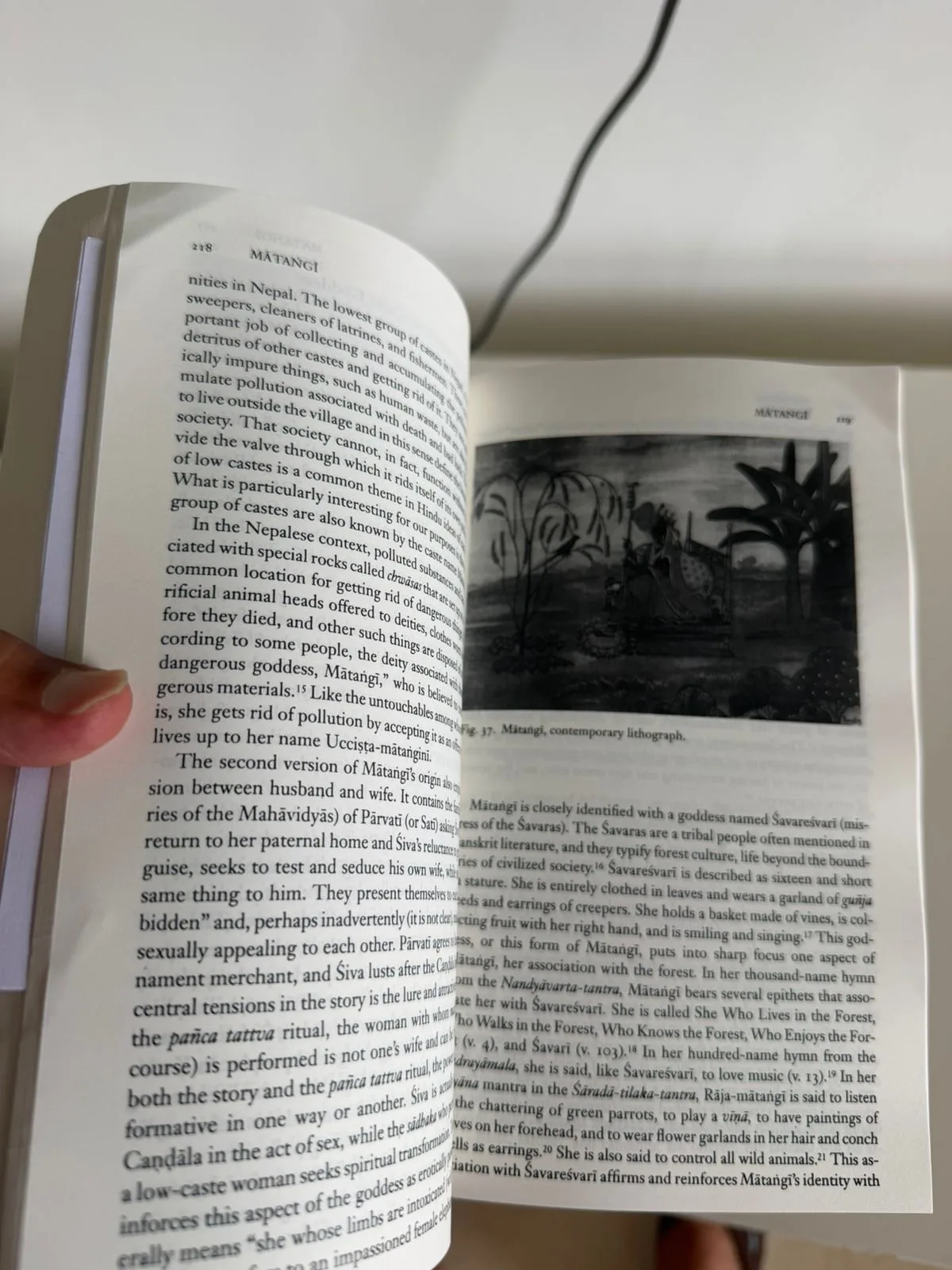
I found this astonishing. Here is a tradition that takes the very thing a purity-obsessed culture fears most — contamination, the outsider, the rejected — and makes it sacred. Kinsley’s insight is quietly radical: an obsession with purity can itself become dangerous and destructive, and to consciously touch the forbidden can be liberating. Reading it, I felt the book gently loosen a knot I did not know I was carrying — about worthiness, about belonging, about the parts of ourselves we are told to hide.
“To intensely embrace the forbidden, once and for all, and in so doing to overcome it — this can be direct and liberating.” — paraphrasing Kinsley on Matangi and the low-caste goddess
Why This Knowledge Moved Me So Deeply
What struck me most is how tender the scholarship is beneath its rigour. Kinsley is never shocked by these goddesses, and he never sanitises them. He lets them stay difficult. He shows how women — and really all of us — are handed narrow “models” of who to be, and how the Mahavidyas crack those cages open.
These goddesses are angry, erotic, grieving, powerful and free in ways the world rarely permits, least of all in a woman. Sitting with them for a few hundred pages, I came away with more compassion for myself and a far wider sense of what the sacred is allowed to look like. As a mother, a wife, an entrepreneur who has known both building and losing, I needed to be reminded that the Mother is not only the gentle one who blesses. She is also the fierce one who destroys what must end, the widow who knows loss, the outcaste who redeems the rejected. All of it is Her.
A rare book that is both deeply scholarly and quietly transformative. Read it slowly.
Who I’d Give This Book To
- Anyone drawn to the Divine Feminine, Shakti, or goddess spirituality.
- Readers curious about Tantra beyond the clichés and misconceptions.
- Anyone quietly wrestling with ideas of purity, worthiness, fear and power.
- Lovers of mythology, symbolism, and Indian sacred art.
A Book I Will Return To
Some books you read. This one reads you back. If you let it, Tantric Visions of the Divine Feminine holds up a mirror and shows you the faces of the Mother you were never taught to honour — the fierce, the grieving, the outcaste, the abundant. I closed it feeling held, and seen, and gently expanded. That, to me, is the mark of knowledge that truly matters.
I write this not as a scholar — I am only a seeker who was moved. If something in these words has stirred you, it is not because of me. It is Her. Always Her.
Further Reading & Sources
- Tantric Visions of the Divine Feminine — the book, at University of California Press
- Reader reviews on Goodreads
- The Ten Mahavidyas — an overview of the system of wisdom goddesses
- Shakti and Tantra — the tradition this book belongs to
- My reflection on Devi Tara — a companion piece to this one